
Local Area & Community · Frederick, MD
Living in Frederick, Maryland: The Complete 2026 Guide
By Margo Miller, REALTOR® · Rightsizing Specialist · New Construction Specialist · Relocation Specialist · Trish Mills Team | Charis Realty Group
Quick Answer
Living in Frederick, Maryland means a mid-sized city at the junction of I-70 and I-270, about 50 miles northwest of Washington, DC and 65 miles west of Baltimore, at the foot of the Catoctin Mountains. It anchors a county that also includes Urbana, Middletown, Walkersville, New Market, Thurmont, Ijamsville, and Myersville. The economy runs on Fort Detrick, Frederick Health, the I-270 bio-health corridor, and agriculture. Housing spans historic rowhomes, mid-century ramblers, 1990s subdivisions, new construction, and 55+ communities.
Where Frederick Sits
Geography explains most of what Frederick is. The city occupies a broad valley where the Piedmont gives way to the Blue Ridge, at the foot of Catoctin Mountain. Two interstates meet here: I-70, running east to Baltimore and west toward Hagerstown, and I-270, which begins at that junction and runs southeast through Montgomery County to the Capital Beltway. US-15 carries traffic north toward Thurmont and Gettysburg and south toward Leesburg, Virginia, while US-340 splits off toward Harpers Ferry.
Those roads made Frederick a crossroads in the 1700s, and they are why the county reads so differently end to end. A home in 21704 is minutes from an I-270 on-ramp. A home in 21788 near Thurmont is a half hour north, under the mountains. Same county, different commute, lot size, and housing stock.
The City Versus the County
Newcomers use “Frederick” to mean two things. The City of Frederick is an incorporated municipality with its own mayor, aldermen, and zoning code, covering the 21701, 21702, and 21703 ZIP codes and part of 21704. Frederick County is the larger jurisdiction around it, holding twelve municipalities plus a great deal of unincorporated land. City and county addresses can carry different utilities, tax lines, and permitting offices, so confirm early. The towns compare like this; drive times are approximate.
| Town / Area | To downtown Frederick | To the I-270 corridor | Dominant housing type | Built environment |
|---|---|---|---|---|
| Frederick City (21701, 21702, 21703) | 0–10 min | 5–15 min | Rowhomes, detached, townhomes, condos | Historic core plus suburban edge |
| Urbana (21704) | 15–20 min | 0–5 min | Detached, townhomes | Master-planned, village centers, trails |
| Ijamsville (21754) | 15–20 min | 5–15 min | Detached, larger lots | Rural crossroads, large-lot subdivisions |
| New Market (21774) | 15–20 min | 15–25 min | Detached, townhomes | Historic main street, planned subdivisions |
| Walkersville (21793) | 10–15 min | 20–30 min | Detached, townhomes | Small-town grid, farmland edge |
| Middletown (21769) | 15–20 min | 25–35 min | Detached single-family | Historic main street, mountain valley |
| Myersville (21773) | 20–25 min | 30–40 min | Detached single-family | Rural crossroads at an I-70 interchange |
| Thurmont (21788) | 25–35 min | 35–45 min | Detached, some condominium | Small town main street, mountain base |
Downtown and Carroll Creek Park
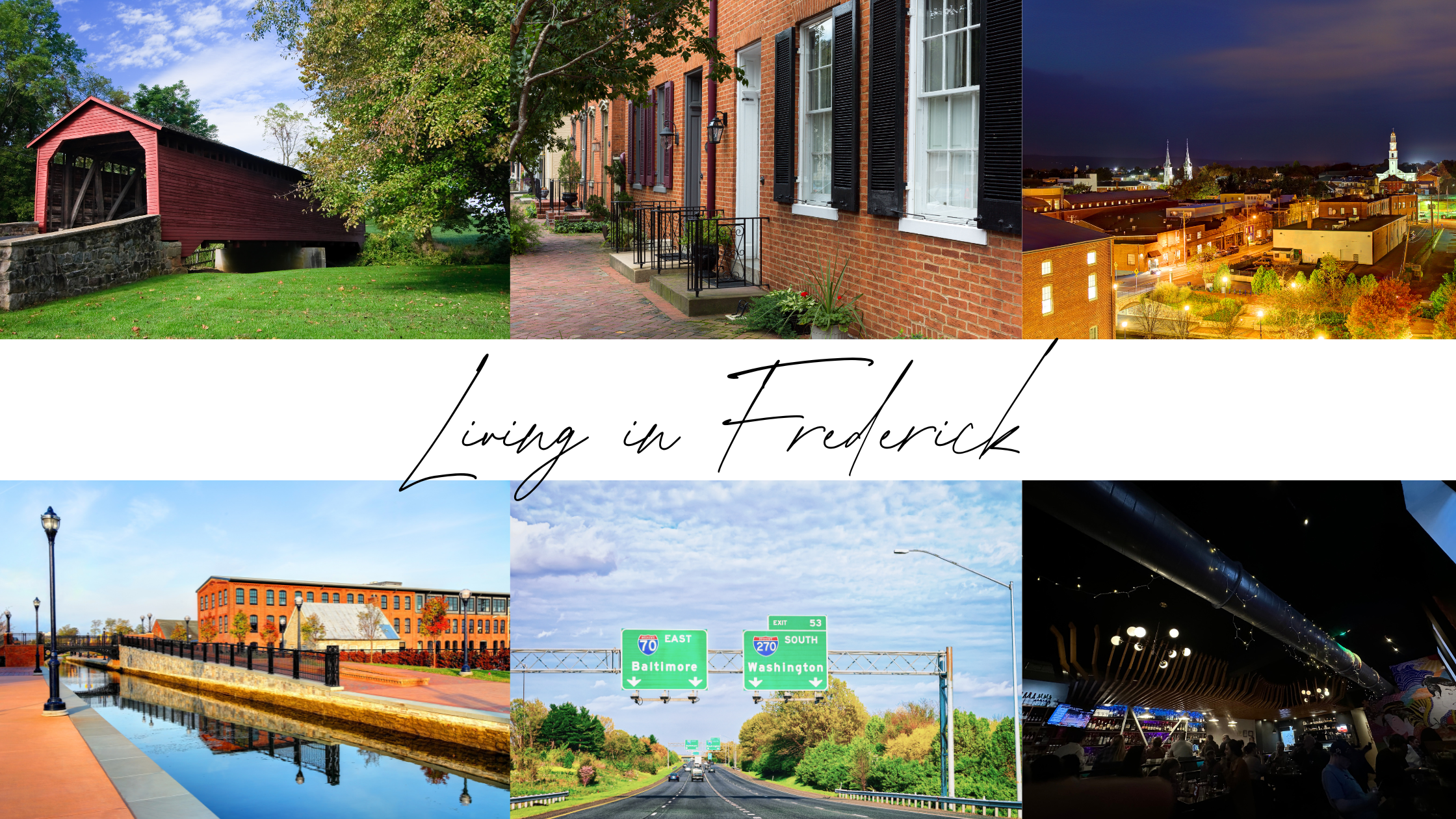
Downtown Frederick is why many people stop looking anywhere else: a fifty-block historic district of brick sidewalks, nineteenth-century masonry, and independent storefronts along Market Street and Patrick Street, unusually walkable for a city this far from a major metro.
Carroll Creek Park runs through the middle of it. The canal, pedestrian bridges, amphitheater, and promenade of restaurants began as flood control after the 1976 flood: the creek was channeled underground, and the surface above became public space. It carries the Sailing Through the Winter Solstice light installation each winter and the Color on the Creek water lilies each summer. The City of Frederick maintains the park, and Visit Frederick publishes the event calendar.
“Frederick is not a bedroom community that happens to have a downtown. It is a working city that happens to sit within reach of two of them.”
The Economy
Fort Detrick is the largest employer in both the City and the County of Frederick, according to the Maryland Department of Planning’s military installation profile. A medical-research and communications installation rather than a combat post, it supports five cabinet-level agencies: Defense, Veterans Affairs, Agriculture, Homeland Security, and Health and Human Services. Tenants include the U.S. Army Medical Research and Development Command, the National Cancer Institute at Frederick, Naval Medical Logistics Command, the 21st Signal Brigade, and a VA Community Based Outpatient Clinic. The Maryland Department of Planning’s military compatibility program reported roughly 66,000 direct, indirect, and induced jobs regionally and about $11.2 billion in annual output for FY2021. Arriving on orders? The Fort Detrick relocation guide goes deeper.
Around it sits a dense cluster of life-science employment. Frederick Health runs the county’s hospital and a network of outpatient locations, and contract research organizations, manufacturing sites, and laboratories stretch down the I-270 corridor into Montgomery County. Anyone moving for a hospital or laboratory position should start with the healthcare and biotech relocation guide.
Agriculture is a working industry here, not scenery: Frederick County ranks among Maryland’s leading agricultural counties by production, with dairy, grain, orchards, and a growing agritourism sector of farm markets and creameries. Add several hundred independent downtown businesses, and no single employer carries the county.
Housing Stock by Type and Era
Historic downtown
Two- and three-story brick and frame rowhomes, mostly nineteenth century, on small lots with rear courtyards or alley parking. Expect heart-pine floors, tall windows, and the maintenance profile of a 150-year-old building. Inside the historic district, exterior changes go through the city’s Historic Preservation Commission.
Mid-century
The ring just outside the core holds 1950s through 1970s ramblers, Cape Cods, and split-levels on quarter-acre lots with mature trees. These are the county’s most common single-level floor plans.
1990s and 2000s subdivisions
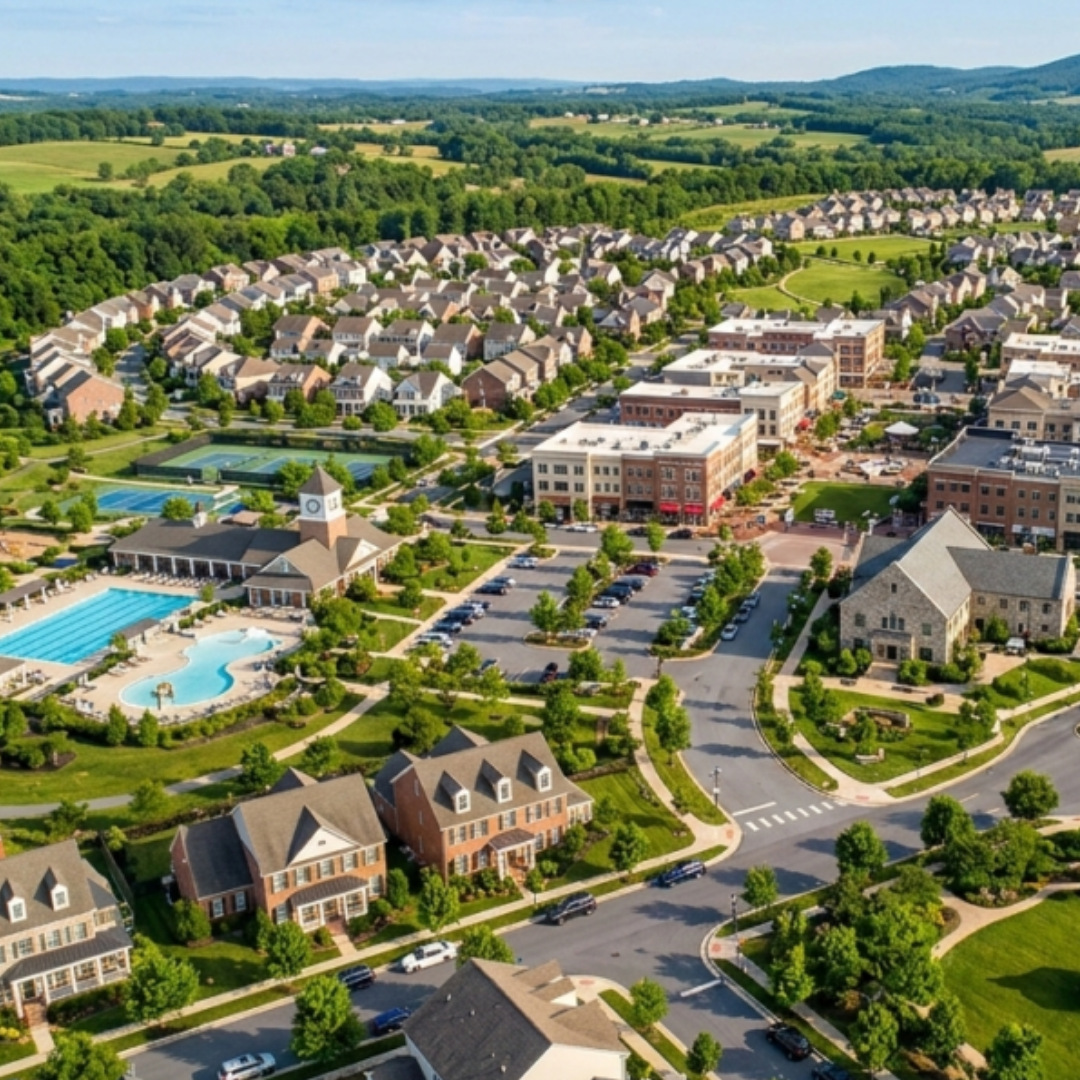
Colonial-style detached homes and townhomes, two stories with attached garages and full basements, concentrated in 21702, 21703, and 21704 and in Urbana, Walkersville, and Lake Linganore. Most carry a homeowners association.
Current new construction
Building continues at Westview South and Ballenger Run south of the city, along the Urbana corridor, and at the county’s two active adult communities, Bloomfields north of downtown and Cromwell in Oakdale, with townhomes, villas, and detached homes from national and regional builders, each on its own contract, timeline, and inspection sequence.
55+ active adult
Roughly a dozen age-restricted communities, new and resale, spanning condominiums, villas, townhomes, and detached homes. Under the federal Housing for Older Persons Act, at least one resident per home must be 55 or older, and the community must meet the occupancy, written-policy, and age-verification requirements the law sets. Floor plans commonly include first-floor primary suites and zero-step entries. The guide to 55+ communities in Frederick, Maryland lists them with approximate prices.
Three Facts Worth Knowing Before You Shop
- The Institute for Luxury Home Marketing sets Frederick County’s luxury threshold at $670,000, a benchmark it revises periodically.
- Maryland’s customary practice is a 50/50 split of transfer and recordation taxes between buyer and seller, though that is negotiable in the contract. Confirm specifics with your closing attorney or title company.
- Median sale price, days on market, and inventory: in September 2026, Frederick County’s median sale price was $481,145, about two out of three homes that sold went under contract within 30 days, and 944 homes were for sale at month’s end, roughly 3.1 months of supply (Bright MLS).
Getting Around
I-270 is the spine of the Washington commute, running from the Frederick junction through Urbana, Clarksburg, Germantown, and Rockville to the Beltway. I-70 handles the Baltimore direction toward I-695 and I-95. US-15 is the north-south artery through the city, and US-340 runs toward Virginia and the Eastern Panhandle of West Virginia.
Rail is the alternative. The MARC Brunswick Line serves a station on East Street downtown and a second at Monocacy off Route 355, running weekday peak trains into Washington Union Station by way of Point of Rocks. TransIT Services of Frederick County operates local buses, and MTA commuter buses serve the Shady Grove and Rockville Metro stations. Ride or drive the route at the hour you would really be traveling it, both directions, before committing.
Parks, Trails, and the Outdoors
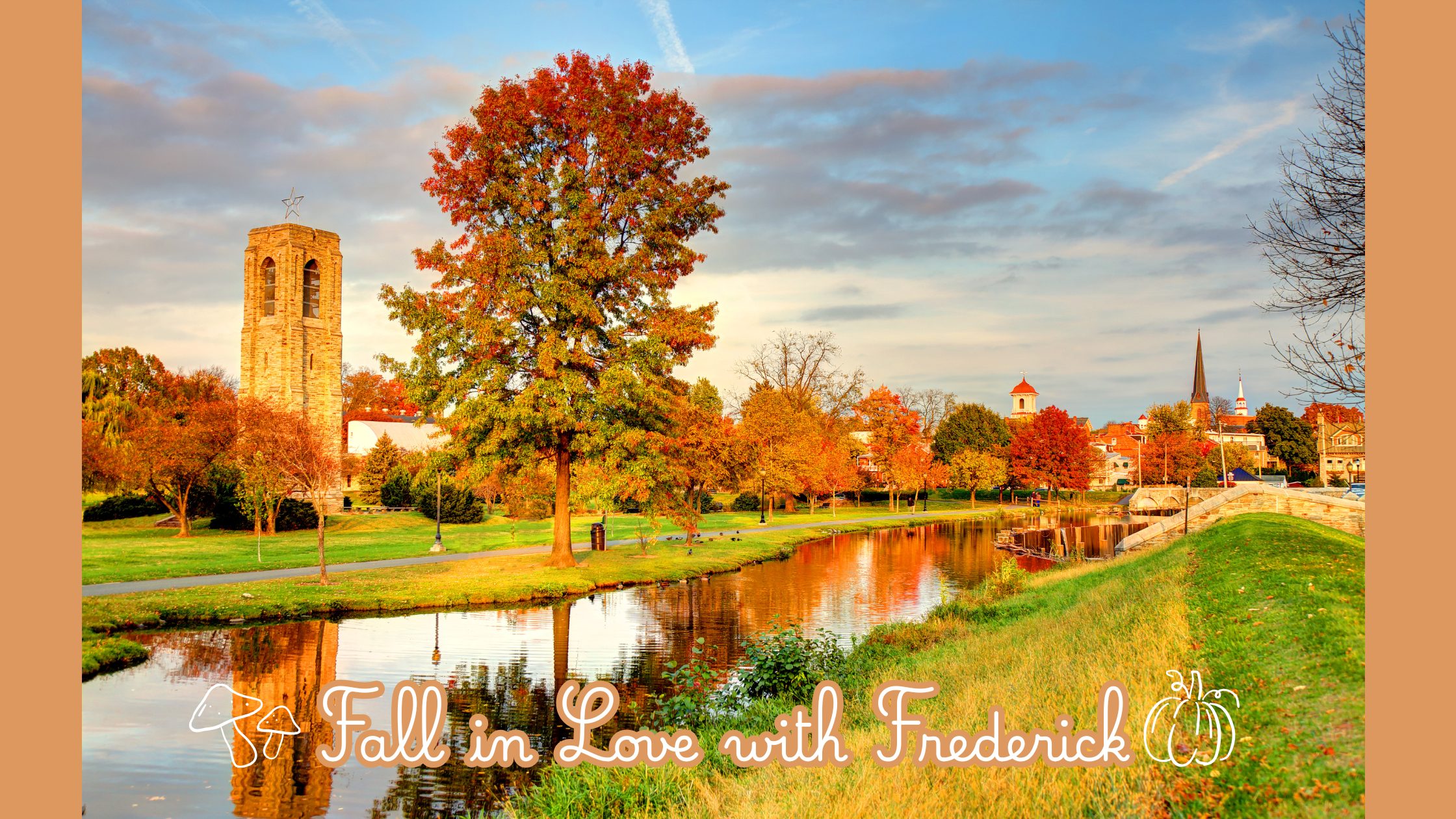
Baker Park covers about 44 acres at the western edge of downtown, with a bell tower carillon, tennis courts, a bandshell, and a walking loop. West of the city, Gambrill State Park offers ridge-top overlooks and mountain-bike trails. North of Thurmont, Catoctin Mountain Park and Cunningham Falls State Park face each other across Route 77, sharing a trail system that holds Maryland’s largest cascading waterfall and the Chimney Rock and Wolf Rock outcrops. The Appalachian Trail crosses the county along South Mountain.
Water runs through all of it. The Monocacy River cuts north to south through the county and is paddled and fished along its length, with Monocacy National Battlefield preserving a stretch south of the city. At the southern boundary, the Potomac carries the C&O Canal towpath, reached at Point of Rocks and Brunswick.
Food, Breweries, and the Arts
Downtown restaurant density is high for a city this size, weighted toward independents on Market Street, Patrick Street, and the Carroll Creek promenade. Brewing is a genuine draw: Flying Dog brewed in Frederick for roughly fifteen years and set the pattern, and the county now supports breweries, cideries, distilleries, and vineyards, several on working farms near Middletown and Thurmont.
The Weinberg Center for the Arts is a restored 1926 theater on North Market Street programming film, music, and touring performance, and the Delaplaine Arts Center occupies a former mill on Carroll Creek. Maryland Ensemble Theatre and the Frederick Symphony Orchestra perform locally, First Saturday brings gallery openings downtown, and the Great Frederick Fair fills a week each September.
The Frederick Year
Frederick has four distinct seasons, moderated slightly by the valley. Summers are warm and humid, with July highs commonly in the upper 80s and thunderstorms rolling over the ridge in late afternoon. Autumn is the local peak: mid-October color on the Catoctins, orchard and cidery season, and the weather most people move here for. Winters are cold without being severe on the valley floor, with measurably more snow in Middletown, Myersville, and Thurmont, where elevation adds up. Spring is wet in March, settled by May.
Housing activity follows its own rhythm, building through spring and thinning in deep winter. Whether that pattern holds this year is a question for current data, which is what my quarterly Frederick County market report series tracks.
Frequently Asked Questions
How far is Frederick, Maryland from Washington, DC and Baltimore?
Frederick sits roughly 50 miles northwest of Washington, DC and about 65 miles west of Baltimore. The drive to DC runs down I-270, and the drive to Baltimore runs east on I-70. Travel time varies widely with the hour.
Can you take the train from Frederick, Maryland to DC?
Yes. The MARC Brunswick Line serves the Frederick station on East Street and the Monocacy station off Route 355, running into Washington Union Station by way of Point of Rocks. Service is weekday peak-oriented rather than all-day, so check the schedule.
What kinds of homes can you buy in Frederick, Maryland?
Frederick County spans brick and frame rowhomes downtown, mid-century ramblers and split-levels around the core, 1990s and 2000s colonial subdivisions, current new construction, and 55+ active adult communities. Lot sizes run from a downtown courtyard to several acres.
What is there to do in Frederick, Maryland?
Downtown Frederick has a walkable core of independent restaurants, breweries, galleries, and the Weinberg Center for the Arts, set around Carroll Creek Park. Baker Park, Gambrill State Park, Catoctin Mountain Park, Cunningham Falls State Park, and the C&O Canal towpath are all close by.
Is Frederick, Maryland part of the DC metro area?
Frederick County is included in the Washington-Arlington-Alexandria metropolitan statistical area, and its southern end along I-270 is part of the region’s biotech corridor. Frederick also has its own employment base in Fort Detrick, Frederick Health, and agriculture.
Thinking About a Move to Frederick, MD?
Tell me where you need to be on a Tuesday morning and what you want to come home to, and I will map the parts of Frederick County that fit both.
Call or text: 301-524-0999 · Margo Miller, REALTOR® · Trish Mills Team | Charis Realty Group
We are committed to the letter and spirit of U.S. policy for the achievement of equal housing opportunity throughout the nation. We encourage and support an affirmative advertising and marketing program in which there are no barriers to obtaining housing because of race, color, religion, sex, handicap, familial status, or national origin. Margo Miller, REALTOR® | Trish Mills Team | Charis Realty Group | 301-524-0999 | Broker: 240-776-8444.





Leave A Comment